
Intrapersonal intelligence is one’s capacity to process personally relevant information. It develops gradually in adulthood, and is significant for smooth interaction with the culture and society. Moran and Gardner (2018) provided an insightful article about intrapersonal intelligence. I summarized the important points in this article.
In terms of executive function, intrapersonal intelligence has 3 parameters namely hill, skill, and will. It develops into 3 stages: apprentice, master, and contributor. Both the executive function and development of intrapersonal intelligence are influenced by the social and cultural environment.
Executive Function and its 3 Parameters
Hill – goal, or the self one aspires
Skill – ability to attain the goal
Will – perseverance to achieve the goal
For example, an adult aims to learn how to invest in the stock market online [hill] may use his existing knowledge on business mathematics [skill] and perseveres amid some losses [will] so as to get the desired result through time.
Developmental Stages of Intrapersonal Intelligence
1. Apprentice
In this stage, one’s identity is largely influenced by societal and cultural expectations. Hill is aligned with what is socially/culturally expected as the skills learned also stem from the societal and cultural standards. Hence, the individual is motivated [will] to focus on developing skills that are socially deemed useful for ‘getting ahead’ in life. For example, Clara has a goal of being a lawyer [hill]; hence, using her communication [skills], she continues to study law after graduating from college. She thought that her profile and skills, as what others also see, match the law profession and she can gain prestige and earn more by being a lawyer – this is what motivated her to pursue the goal [will]. Many people stop in this stage as they are already comfortable being aligned with the societal/cultural standard.
2. Master
In this stage, one’s thinking is personally defined and controlled. The know-how [skill] is continually honed to achieve a personally chosen goal [hill] which may be of little value, may not be supported by, or against the dominant societal and cultural expectations. Because of this, there are more obstacles in reaching the hill, and so the will is more determined to achieve the goal especially in times of uncertain and sudden changes.
It is in this stage that authenticity agency is harnessed in terms of engaging in self-directed learning and through interpolation – the ability to bring self-knowledge in processing information. Clara, after graduating from law, went to practice for 8 years. She now has another goal [hill] of making use of her expertise [skill] to help people who were incarcerated for crimes they were wrongfully judged. In the society she lives in, there is little government budget for legally assisting these people and there may be strong resistance from previous people and authority involved. Nevertheless, Clara continues to fight for the cause amid external pressures because she believes this is how she identifies herself – this is a reflection of strong will.
3. Contributor
This is the highest stage only few people attain in their lifetime. Individuals in this stage not only exercise their authentic agency, but also persevere to influence the course of development of their culture. As Clara continues to willfully engage and wins fights in helping wrongfully incarcerated individuals, she creates an outcry questioning the status quo which through time may influence the culture of the profession and even how society views this relevant issue.
Implications to Teaching
It is clear that the development of intrapersonal intelligence and its three parameters are influenced by the social and cultural environment. Apprentice stage, for example, sets the standard for an individual’s goal and motivation. The individual in the master stage gets out of the comfort zone and applies his/her knowledge in understanding the nuances in different cultures transcending expectations in the sociocultural sphere where he/she belongs. Then, he/she challenges the status quo and influences the course of the culture. Different learners come from different upbringing, backgrounds, and culture; hence, culturally relevant teaching is necessary.
One of the skills reflective of intrapersonal intelligence is being tactful, the ability to express oneself while being sensitive to others. There are 3 culturally relevant strategies to teach tactfulness.
Country/Culture Introduction
I can create a culturally sensitive learning session through an activity that informs all learners on where their co-learners’ country of origin is. I can present them a map wherein they can put a mark on their country. After all learners put their mark, each learner is given one minute to introduce himself/herself and name one characteristic feature which he/she believes to be unique in their culture. After introduction, all learners are given one minute to react and ask questions to the learner who introduced himself/herself. Everyone is given the opportunity to introduce. Through this activity, learners will know more about each other and will realize that there are both differences and similarities across cultures, that experiences across cultures are important aspects of learning, and these can be a jump off point for being tactful.
Cultural Insights
Another activity, which I usually give to a culturally diverse workshop, is what I call cultural insights. As a group, we go to Hofstede’s website on country-specific cultural comparison. For 15 to 20 minutes, we compare the 6 cultural dimensions across countries. These dimensions are power distance, individualism, masculinity, uncertainty avoidance, long term orientation, and indulgence. Acknowledging these dimensions facilitates interaction from the learners, making them more sensitive to those whom they are interacting. This is also a non-threatening way of discussing cultural differences – a culturally relevant activity I look forward to in my workshops as it seamlessly activates interaction among learners.
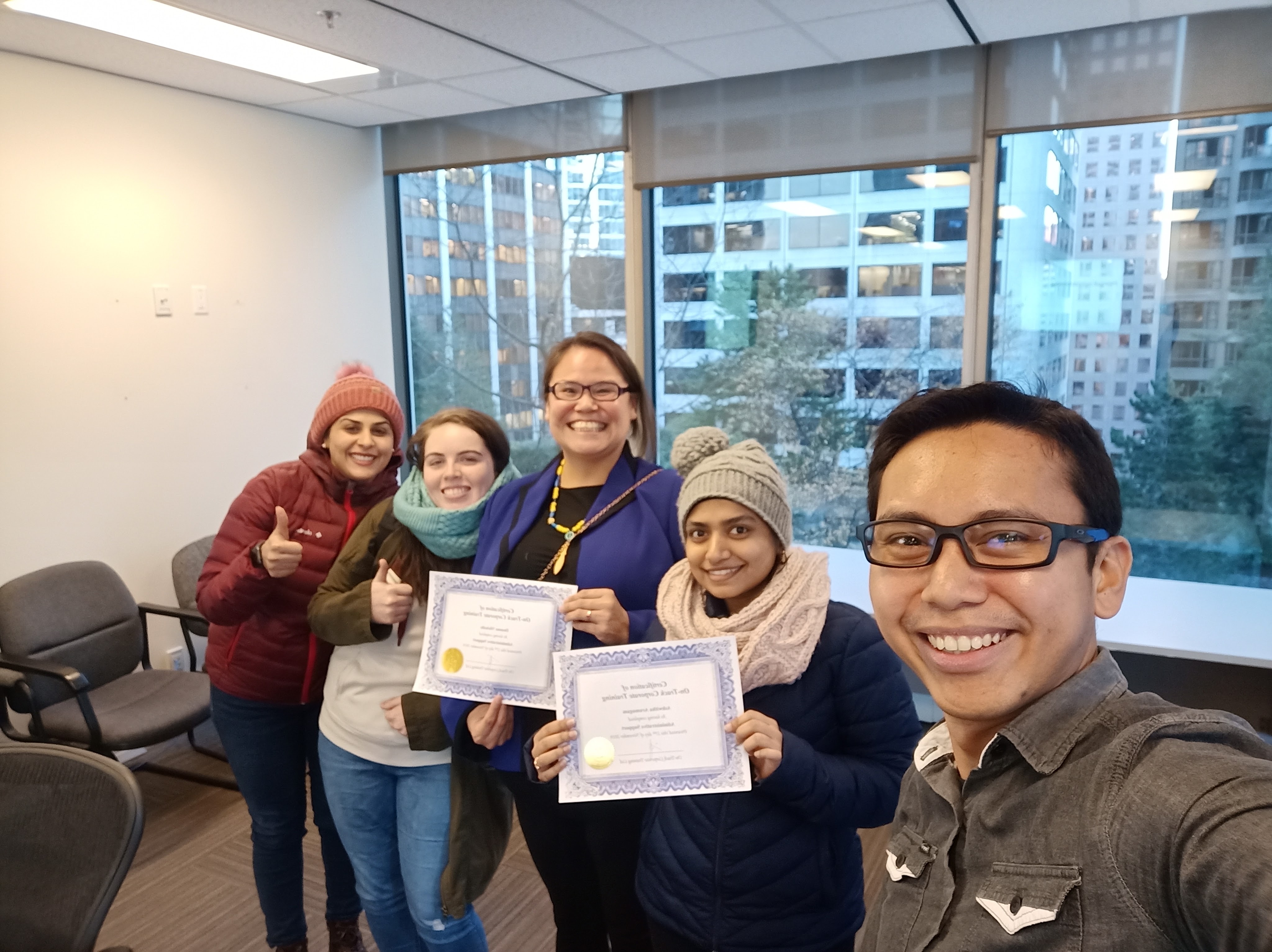
(ON-TRACK Corporate Training, Vancouver, BC, Canada)
Story Telling
We are social beings. It is our need to connect to others. We can satisfy this social need by sharing our thoughts and feelings. Through sharing our own story with others, we satisfy our need to connect, understand others, and develop a positive attitude to people from different cultures.
A storytelling activity is also a powerful facilitator of cultural sensitivity. The goal of this activity is to recognize that the experience and “story” of an individual is a way of knowing in itself. For 3 to 5 minutes, each learner is given the opportunity to tell a story about learning a skill that they value the most in their life. After telling the story, another 3 to 5 minutes is given for reactions and questions. Everyone takes their turn. Most of the time, through their interaction with the story teller, the learners will realize that there are skills which are culturally specific and which are also learned in different ways across cultures.
In the end, there is no learning authority higher than the learner as the learner is the authority in its own right. It is our idiosyncratic collection of experiences that makes us a learned being.
Main reference: Moran, S., & Gardner, H. (2018). Hill, skill, and will: executive function from a multiple-intelligences perspective. In L. Meltzer (Ed.), Executive function in education: From theory to practice (p. 25–56). The Guilford Press.
Acknowledgment: I offer my deep appreciation to Orville dela Cerna (Legal Officer, Department of Education – Cebu) and Ma. Jhorenda Macion (Assistant Professor, University of San Carlos) for their comments on the draft of this article.

 flowjame
One thought on “Intrapersonal Intelligence: Executive Function, Development, and Implications to Teaching”