
What is Hidden Curriculum?
Hidden curriculum is generally acknowledged as the socialization process of schooling (Kentli, 2009). In contrast to the explicit curriculum which anchors on what is written in the syllabus, the hidden curriculum portrays those which the instructors teach but are not explicitly written (Drew, 2020). It is this idea of socialization that interests me the most.
How do Hidden Curriculum and Culture Interact?
Durkheim (1925) argued that academic institutions teach us how to behave in a society through socialization in the classroom. As a social psychology practitioner, I am familiar with culture’s influence on emotions, thoughts, and behaviors; however, these theoretical concepts became more salient when I started experiencing teaching and learning in two different cultures – Canada and the Philippines. I am currently teaching as a soft skills instructor in Vancouver and a university lecturer in the Philippines. In my experience, Filipino learners view asking questions about the lesson as a sign of incompetence and Canadian learners view it as an indicator of being engaged. In terms of sharing ideas, Canadians readily share their ideas whereas Filipinos take their time as a subtle way of showing modesty despite having an idea about the topic. This difference may have been reinforced by the institution’s hidden curriculum. These are some of the differences I observed as I continue to experience teaching and learning in the individualist (Canada) and collectivist (Philippines) culture.
Teaching in both cultures, I tend to act in ways that elicit behaviors expected from a collectivist culture – the culture which I am more exposed to. For example, I am fine with a quiet class because in a collectivist culture this may indicate that the students have already explored the materials ahead of time and are able to understand the discussion. However, with the concept of hidden curriculum, there are cultural nuances in interpreting this situation. In an individualist culture, it may indicate disengagement but in a collectivist culture it may indicate understanding and/or modesty. Watkins (2000) found that Eastern students prefer to ask questions based on what they have read in the materials ahead of time and prefer to be silent if there is no need for clarification (which Western students find disengaging). On the other hand, Western students ask because they do not know (which Eastern students consider as rude). These are not explicitly written in most of the learning programs but are observed during learning sessions. In a broader sense, the socialization process in school that Durkheim referred to is culture’s impact in the hidden curriculum. Hence, the socialization process at school – broadly reflective of culture – is an interesting point that I need to consider both in my teaching and learning activities.
Studies indicated that hidden curriculum is influenced by culture. Individualist cultures (e.g., Canada) put more value on independence or self-reliance, individual achievement, and self-expression whereas collectivist cultures (e.g., Philippines) put more value on interdependence or cooperation, group success, and modesty (Merriam & Kim, 2011; Rothstein-Fisch & Trumbull, 2008). This may be a reason that Asian adults prefer to receive recognition as part of a group and not as an individual (Plaud & Markus, as cited in Wlodkowski, 2008).
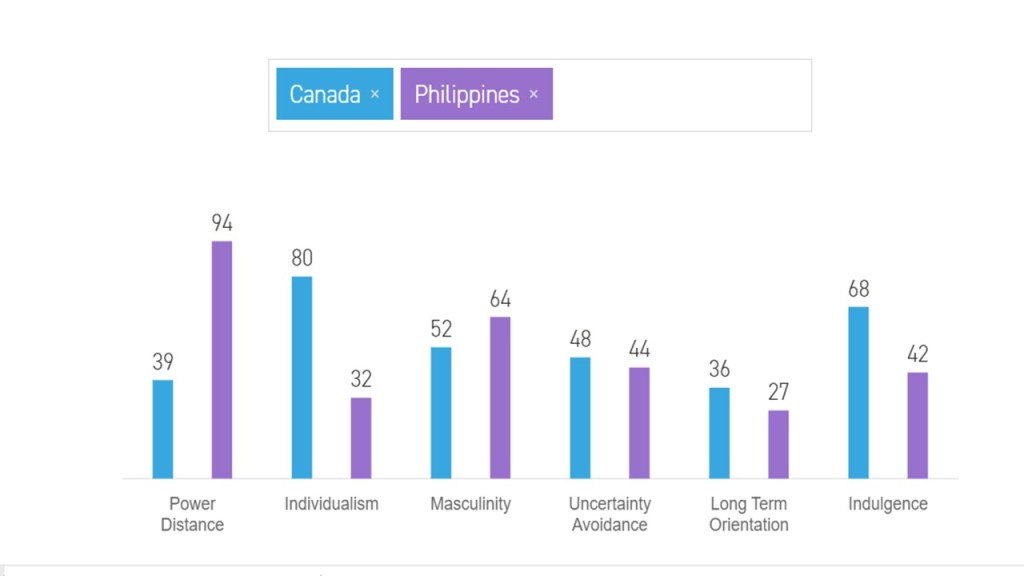
Drew (2020) cited general advantages and disadvantages of hidden curriculum. One of the advantages is for preparing students how to navigate in the culture and society. In my current situation as an immigrant, going to school and interacting with my Canadian classmates are ways for me to adjust to a new culture. On the other hand, one of the disadvantages is reinforcing social inequalities wherein those in the minority and in the lower socioeconomic status are continually compelled not to complain and not to question the status quo. Hence, hidden curriculum may perpetuate inequality in class relations (Willis, 1977). The point is that a hidden curriculum has its positive and negative influences on the learner and being aware of such influences make the learning experience more impactful.
What are the Implications of Hidden Curriculum in Teaching and Learning?
Knowing the concept of hidden curriculum may help me as a student and as a teacher. As a student who continually learns in my field of interest, I have to be mindful of the sociocultural expectations of the organization or the academic institution I am in. Although largely unwritten, I have to abide by the institution’s values and expectations, while also keeping my own. I consider this as an on-going task that I need to learn little-by-little.
As a teacher, I believe one of the ways to eliminate the negative impact of hidden curriculum is to explicitly present it in a written document to the class. I have to let my students know about my teaching philosophy and how it applies to the course (e.g., expectations from the students, class routine, communicating with the students and teacher, learning relationship). This gives my students a glimpse of who I am, my values, my capacity, and my learning and social expectations in class. Positive teacher-student relations and preference for cooperative learning environments facilitate belongingness even in a culturally diverse classroom (Cortina, Arel, & Smith-Darden, 2017). In this connection, modeling culturally sensitive behaviors in the class ensures that these are acknowledged and reinforced. Hence, in both individualist and collectivist learning sessions, I have to make sure that I establish respectful learning relationships with my students and co-teachers, and emphasize sharing of ideas and contributing to group work as essential factors of both individual and group success.
In general, a hidden curriculum is a reflection of sociocultural expectations, and these expectations are largely unwritten rules. Values, attitudes, and beliefs are inevitable part of the class dynamics, and so the hidden curriculum is always there. What do you think? How is hidden curriculum influencing your teaching and learning experiences?
References
Cortina, K. S., Arel, S., & Smith-Darden, J. P. (2017). School belonging in different cultures: The effects of individualism and power distance. Frontiers in Education, 2, 1 – 11. https://doi.org/10.3389/feduc.2017.00056
Drew, C. (2020). What is hidden curriculum? – Examples, Pros, and Cons. https://helpfulprofessor.com/hidden-curriculum/#1
Durkheim, E. (1925). L’éducation morale [Moral education]. Paris, France: Alcan/PUF.
Kentli, F. (2009). Comparison of HC theories. European Journal of Educational Studies, 1(2), 83 – 88.
Merriam, S. B., & Kim, Y. S. (2011). Non-western perspectives on learning and knowing. In S. B. Merriam & A. P. Grace (Eds.), The Jossey-Bass Reader on Contemporary Issues in Adult Education (pp. 378–389). San Francisco: Jossey-Bass.
Rothstein-Fisch, C., & Trumbull, E. (2008). Managing diverse classrooms: How to build on students’ cultural strengths. ASCD.
Watkins, D. (2000). Learning and teaching: A cross-cultural perspective. School Leadership and Management, 20(2), 161 – 173. https://doi.org/10.1080/13632430050011407
Willis, P. (1997). Learning to labour. New York: Colombia University Press.
Wlodkowski, R. J. (2008). The Jossey-Bass higher and adult education series. Enhancing adult motivation to learn: A comprehensive guide for teaching all adults (3rd ed.). Jossey-Bass.
Acknowledgment: I would like to extend my gratitude to Dwayne Harapnuik, PhD of Vancouver Community College School of Instructor Education for the feedforward of the previous version of this article.

 flowjame
Thank you so much for sharing your insights into the behaviours of different students from different cultural backgrounds. That is fascinating!
I found your article while doing research for my own paper in PIDP 3210 🙂
I appreciate the help!
LikeLike
You are most welcome! I’m happy that my ideas are able to help you.
LikeLike
Hello Nina! Thank you for your insights. I looked into the document you sent – I agree, it is a good resource for knowing more about HC. Happy to know that you are also giving more importance to learner-centered ideologies. Technology has been exponentially growing and it influences the way learners learn, so centering the instructional strategies on their needs is crucial.
Warm regards,
jame
LikeLiked by 1 person
Great article! We often discuss the learning and teaching dispositions, but it is a long time since I have seen an article about HC, which was an important part of my own M.Ed. degree back in Finland. 🙂 Curriculum theory also discusses the different ideologies and cultural emphasis on CC. Schiro’s book is one of the most popular ones, I think, and I like how it clearly displays the epistemologies behind CC and HC (e.g. positivist behind Scholar Academic and constructivist behind Learner Centered).
This will get you started: https://www.sagepub.com/sites/default/files/upm-binaries/47669_ch_1.pdf
I personally (and professionally) lean towards the learner-centered ideologies, therefore I like the way you describe making the hidden rules more visible by establishing cooperative relationships in the classroom (whether online or offline).
🙂
Nina
LikeLiked by 2 people