
One of the most frustrating teaching experiences is when I observe that students resist learning. It is frustrating in the sense that as a teacher, I am seeing that the opportunities I provided to students to share their thoughts, feelings, and experiences are not valued.
A recent experience I had was facilitating a face-to-face learning session about team development among 8 youth participants. One girl, for the first 3 hours, was not showing any interest by not participating and not giving clear responses to my prompts and questions. I let her be while occasionally asking some of her ideas during the discussion. Eventually, by the afternoon session, the light physical activities warmed her up – I started to see her smile and enjoy the activity. This made me realize that all students, whatever their reason is, need to warm up and eventually open up on their own but it needs patience on my side and a warm welcoming environment.
Brookfield (2015; chapter 16) warned about the ‘trap of conversational obsession’ wherein a teacher may become invested in his/her effort to convert the resistant learner to the extent that he/she may neglect the learning needs of the rest of the class. I was relieved to realize that I did not fall into this trap. What I experienced may be reflective of what Brookfield called a normal rhythm of learning which refers to resistance as part of the fluctuation to learning. Finally, the learning environment is a social environment; thus, providing the resistant learner an opportunity to interact with fellow learners and with the teacher becomes a positive learning experience which may eventually tear down that barrier towards learning (Fenton, 2012).
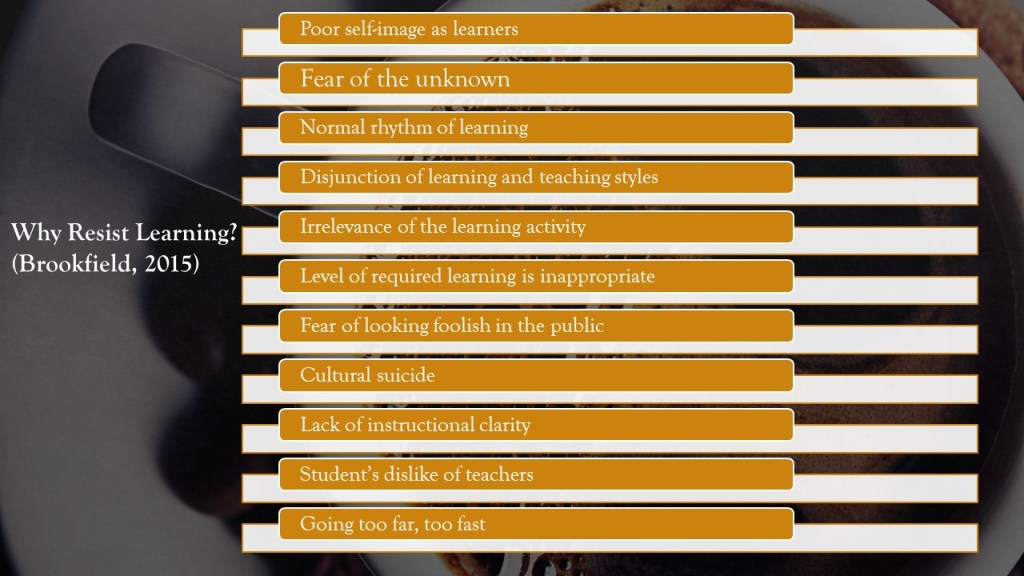
As a teacher, understanding why resistance to learning occurs can help me effectively facilitate the learning session. I expect to meet more resistant learners in the future, so I will make sure to apply what I learned in this chapter.
References
Brookfield, S. D. (2015). The skillful teacher: On technique, trust, and responsiveness in the classroom. John Wiley & Sons.
Fenton, C. (2012). Resistant learners: What aren’t they telling you? Te Iarere Wavelength, 5, 47 – 52. https://www.witt.ac.nz/uploaded_files/Research/TIWissue05.pdf


 flowjame