Expanding Radford’s Theory of Objectification to Teaching and Learning among Young Adult Students of Social Psychology
Capsule learning is my attempt to expand the theory of objectification by incorporating the protection of self-esteem and activation of sociocultural awareness. It is my hope that after reading this blog as a short version of my paper, you will get a grasp of what capsule learning is and its relevance in your respective classrooms.
What is the Theory of Objectification?
Radford (2021), in his theory of objectification, argued to shift the focus of learning from putting the student at the center and creating a separate role for the teacher to engaging in joint labor to produce knowledge. Hence, the emphasis is on the simultaneous effort of the teacher and students in learning and producing knowledge.
However, I noticed that Radford (2021) did not emphasize the willingness of the student to learn. That is, a student has to be motivated in order to take risks in the learning environment. I argue that one way of activating this motivation is to offer a safe learning environment that protects both the teacher’s and the student’s self-esteem. Moreover, the TO process does not take into account that humans do not always engage in conscious and reflective thinking (Shvarts, 2022). Students are not always fully aware of the cultural basis and historical backdrop of the knowledge. They may do the task uncritically most of the time and then in retrospect analyze what happened during the task. With this, I devised a strategy I called ‘surfacing’ that facilitates the transition from just performing the learning task to acknowledging the sociocultural backdrop of the learning (i.e., activation of sociocultural awareness).
How do I incorporate the ideas of self-esteem and sociocultural awareness in the theory of objectification?
I would like to refer to the classroom as a microcosm of sociocultural reality. I call this microcosm the capsule (see figure 1). Sociocultural reality influences the capsule, the teacher, the students, and the learning dynamics. There is a reciprocal influence between the capsule, the teacher, the students, and the learning dynamics. In this regard, I am in line with Radford’s idea that both teachers and students simultaneously work to produce knowledge in the classroom.
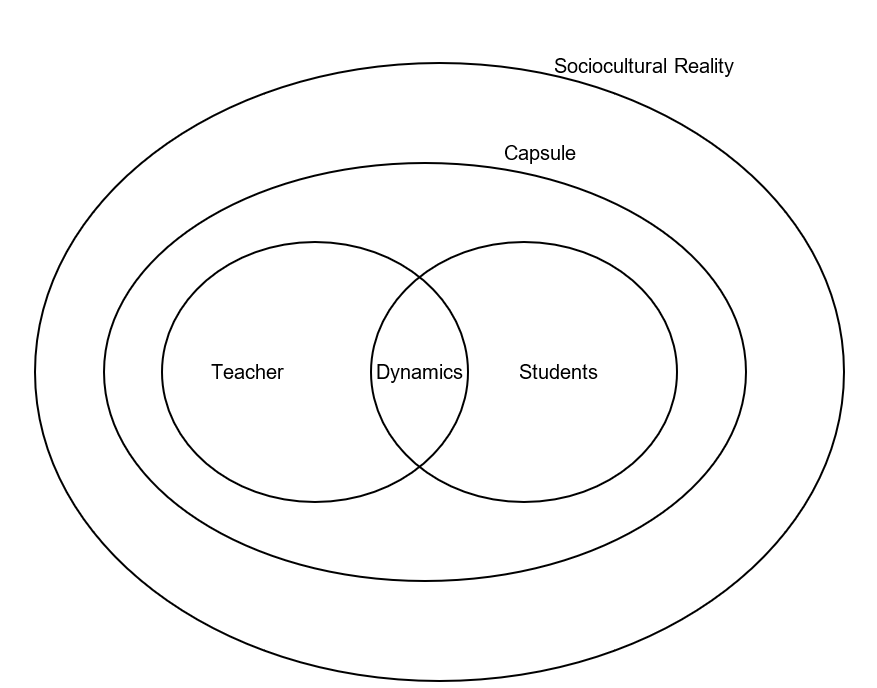
In addition, the capsule is intended to protect the self-esteem of students, creating an environment that increases exploration while taking risks in learning. When outside the classroom (i.e., in the sociocultural reality), these risks may have enormous consequences and detrimental effects on self-esteem.
Capsule learning: What is its relevance?
Producing knowledge is a social activity. The theory of objectification asserts that this activity is a joint labor of the teacher and the students. I want to add vitality to this joint labor by protecting the self-esteem of both the teacher and the students to encourage exploration and risk-taking in learning. Moreover, engaging in productive dialogue activates the awareness of the students regarding the social, cultural, and historical backdrop of the knowledge. Capsule learning puts forward a curricular orientation that encourages social tolerance. This is done in a way that both the students and the teacher coming from various sociocultural backgrounds interact within a class atmosphere that protects their self-esteem and respects each other. Indeed, producing knowledge is a social activity – a learning activity that is relevant to the individual, to the group, and to the sociocultural context.
References
Radford, L. (2021). The theory of objectification: A Vygotskian perspective on knowing and becoming in mathematics teaching and learning. The Netherlands: Brill. Retrieved from https://brill-com.proxy.lib.sfu.ca/view/title/59909
Shvarts, A. (2022). Book review: Transforming mathematics education: From embodied experiences to an ethical commitment. Luis Radford (2021) The theory of objectification: a Vygotskian perspective on knowing and becoming in mathematics teaching and learning. Educational Studies in Mathematics, 109, 677-686. https://doi.org/10.1007/s10649-021-10095-4

 flowjame
2 thoughts on “Capsule Learning”