
One of the global trends in Psychology in the year 2020 is the pursuit of mental health (Weir, 2020). This has been demonstrated in empirical studies, national and international legislation, and the mental health action plan (2013-2020) of the World Health Organization. The goal is to deliver cost-efficient mental health services especially to the developing countries with a limited number of psychologists and mental health professionals. All these while acknowledging and respecting cultural differences in approaches towards attaining mental health.
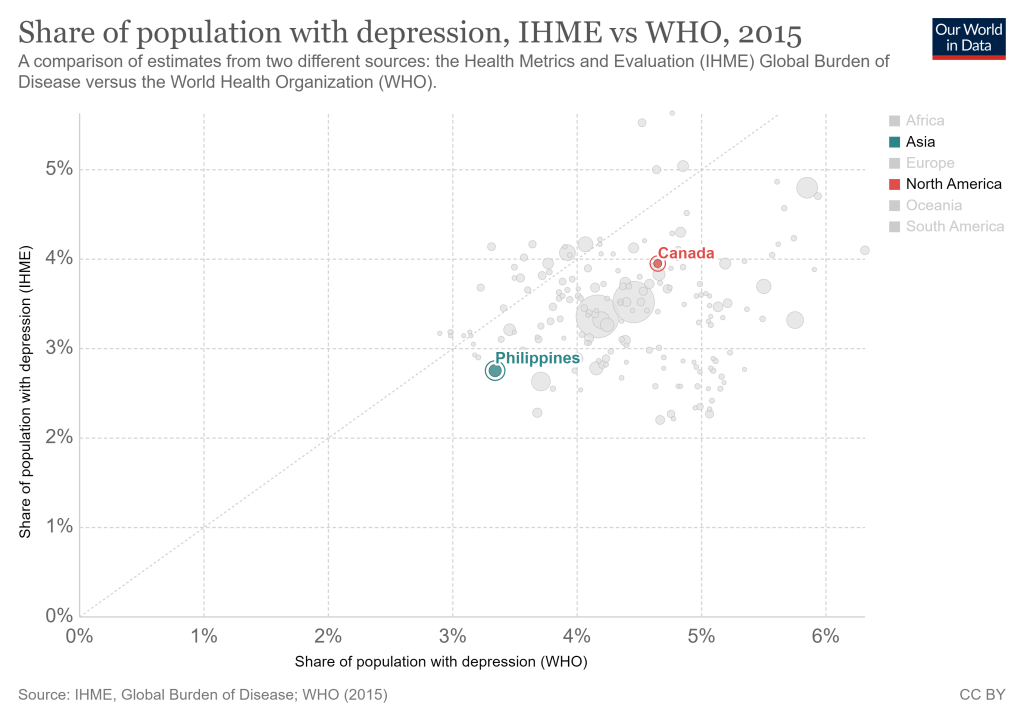
Globally, depression is one of the leading causes of disability (James et al., 2018). In this blog, I present how Canada and the Philippines respond to the call for global action for mental health. Both countries experience a continuing rise in the cases of mental health problems, specifically depression, in recent years (MHCC Case Study Research Report 2017; WHO World Health Survey in the Philippines, 2005 as mentioned in Lally, Tully, & Samaniego, 2019).
Canada and its mental health actions
Starting in the early 1990s, legislation related to mental health in Canada have been created and regularly updated. With 13 mental health acts across its provinces and territories, the common ground rests on the right of an individual to access mental health care voluntarily (O’Reilly & Gray, 2014). Of particular importance is mental health first aid training as a way to increase mental health literacy. I was honored to be able to attend this training in Vancouver last 2019. It was a two-day training where we discussed and learned basic skills on how to respond to individuals experiencing symptoms related to substance use, mood, anxiety, and psychotic disorders. The entire training for me was both memorable and insightful as the participants came from different mental health-related fields (e.g., nurse, psychologist, medical doctor, higher education instructor) who shared their experiences in dealing with mental health problems in both their personal and professional lives.
Since its national drive in 2010, the Mental Health Commission of Canada has been offering various types of mental health first aid training which aim to help vulnerable populations. Integration of mental health literacy in the secondary level’s curriculum has also been successful (Kutcher, Wei, & Morgan, 2015). However, aside from other mental health professionals, there is a continuing shortage of psychologists across Canada and is projected to be the situation until 2028 especially with the rising demand for the work and increasing priority for mental health. More importantly, mental health professionals are working around the clock to address mental health problems in response to the ongoing COVID-19 pandemic.
Philippines and its mental health actions
Republic Act 11036 (Philippine Mental Health Act of 2017) serves as a milestone addressing mental health at a national level (Lally, Samaniego, & Tully, 2019). The Department of Education, through its K+12 program signed into law in 2013, has included mental health concerns in its curriculum starting in the grade 6 level. In the college level, required and elective courses related to mental health are available across programs. As to how this inclusion in the curriculum influences the mental health experience of students remains to be investigated. Regulating the practice of psychology (Psychology Act of 2009) also helped increase the number of mental health professionals attending graduate studies and related training to qualify for a Psychologist licensure examination which was first held in 2014. Psychological first aid (PFA) training for adult learners – which I was able to participate last 2016 – has also been continually offered by the Psychological Association of the Philippines. My insights from PFA training have been helpful especially at times when I encountered mental health problems among students in my class.
Even with the combined human resource of psychiatrists, psychologists, and mental health nurses among other health care workers, there is still a “severe shortage of mental health specialists in the Philippines” (p.63; Lally et al., 2019). With the ongoing COVID-19 situation, mental health concerns are on the spike (Buenaventura, Ho, & Lapid, 2020; Malindog-Uy, 2020), and government and non-profit organizations like the Department of Health (DOH), Philippine Mental Health Association (PMHA), and Psychological Association of the Philippines (PAP) continually exert efforts to address these concerns. The World Health Organization in collaboration with PAP endorsed a list of organizations providing free mental health support amid the pressing COVID-19 situation.
Implications in my teaching and research practice
The salient concern for increasing mental health problems in North America, in the Philippines, and around the world has implications in my teaching and research practice.
Implications in my teaching practice
In terms of teaching adult learners in tertiary level, a course on mental health has to be compulsory. This has been the case with understanding the self course in the general education curriculum in the Philippines. I and my colleagues wrote a book on understanding the self (2018) and emphasized the idea of positive self as a way to create a healthy outlook in life and build meaningful relationships thereby facilitating the experience of flourishing. Philippine Commission on Higher Education Memorandum Orders 34 (series of 2017) and 39 (series of 2010) included the utilization of psychology theories and methods in the learner’s professional and personal life in the learning outcomes in both undergraduate and graduate programs in Psychology. The K-12 mental health curriculum (Roger et al., 2014) and mental health literacy programs for adult learners in Canada have also made strides in putting mental health in the mainstream discussion. Hence, as an adult educator, it is important that I keep updated about mental health information as most of the psychology-related lectures and learning sessions I facilitate inside and outside the academic institutions involve the discussion of mental health.
Implications in my research practice
As a social psychology researcher, I have a vision of facilitating cost-efficient ways to address mental health concerns, not necessarily in a clinical setting, through the use of widely available resources which are also culturally relevant such as religion and spirituality, nature-related interventions, and social support. Approximately 83 percent of the Filipinos are highly religious (Social Weather Station, 2019) and this identity is shared with the family and community (Nadal, 2011). It is estimated that more than half of the young adults in Canada believe in the higher being and that most continue to practice self-defined spiritual activities (Wilkins-Laflamme, 2019). This characteristic features an important resource for coping with stress (Graham, Furr, Flowers, & Burke, 2001) and increasing well-being (Villani, Sorgente, Iannello, & Antonietti, 2019).
The Philippines has an abundance of natural environments including vast marine biodiversity (Avanceña, 2018). Canada, the second largest country in the world in terms of land area and ranked as one of the least densely populated in the world, also presents an abundance of natural environments. Thus, there are plenty of opportunities to connect with nature which has been found to facilitate well-being (Capaldi, Passmore, Nisbet, Zelenski, & Dopko, 2015; Markevych et al., 2017). Evidence-informed initiatives like Mood Walks and David Suzuki Foundation’s 30×30 nature challenge are low-cost activities that promote well-being.
Finally, social support is consistently associated with increased mental health (Harandi, Taghinasab, & Nayeri, 2017). Hence, the high sense of community belonging among Canadian couples with children (Kitchen, Williams, & Chowhan, 2011) and high value assigned to family and community among Filipinos (Pe-Pua & Protacio-Marcelino, 2000) can serve as a social-psychological capital for well-being and mental health.
Where do I go from here?
Keeping myself updated with well-being and mental health research helps me be more sensitive in my instructional strategies and in the way I deliver my lectures in psychology. I can put in my learning outcomes the significance of applying psychological theories and research in one’s personal and professional life. To make it culturally relevant, I have to listen to the adult learners’ different experiences and how it contributes to being a fully functioning person. It is in listening that I let the learner feel valued – a speckle of experience that may lighten up his/her day.
Batara, J. B. (2020, August). Mental health actions in Canada and the Philippines: Implications in my teaching and research practice. Available at https://flowjame.com/2020/08/21/mental-health-in-adult-education/
References
Avanceña, E. (2018). The Philippine environment: Epicenter of wealth, beauty, and destruction. Asia Pacific Perspectives, 15(2), 55-57.
Buenaventura, R. D., Ho, J. B., & Lapid, M. I. (2020). COVID-19 and mental health of older adults in the Philippines: A perspective from a developing country. International Psychogeriatrics, 1–5. Advance online publication. https://doi.org/10.1017/S1041610220000757
Capaldi, C. A., Passmore, H., Nisbet, E. K., Zelenski, J. M., & Dopko, R. L. (2015). Flourishing in nature: A review of the benefits of connecting with nature and its application as a wellbeing intervention. International Journal of Wellbeing, 5(4), 1-16. doi:10.5502/ijw.v5i4.449
Graham, S., Furr, S., Flowers, C., & Burke, M. T. (2001). Research and theory religion and spirituality in coping with stress. Counseling and Values, 46(1), 2-13. https://doi.org/10.1002/j.2161-007X.2001.tb00202.x
Harandi, T. F., Taghinasab, M. M., & Nayeri, T. D. (2017). The correlation of social support with mental health: A meta-analysis. Electronic Physician, 9(9), 5212–5222. https://doi.org/10.19082/5212
James, S. L., Abate, D., Abate, K. H., Abay, S. M., Abbafati, C., Abbasi, N., … & Abdollahpour, I. (2018). Global, regional, and national incidence, prevalence, and years lived with disability for 354 diseases and injuries for 195 countries and territories, 1990–2017: A systematic analysis for the Global Burden of Disease Study 2017. The Lancet, 392(10159), 1789-1858. https://doi.org/10.1016/S0140-6736(18)32279-7
Kitchen, P., Williams, A. & Chowhan, J. (2012). Sense of community belonging and health in Canada: A regional analysis. Social Indicators Research, 107, 103–126. https://doi.org/10.1007/s11205-011-9830-9
Kutcher, S., Wei, Y., & Morgan, C. (2015). Successful application of a Canadian mental health curriculum resource by usual classroom teachers in significantly and sustainably improving student mental health literacy. Canadian Journal of Psychiatry. Revue Canadienne de Psychiatrie, 60(12), 580–586. https://doi.org/10.1177/070674371506001209
Lally, J., Samaniego, R. M., & Tully, J. (2019). Mental health legislation in the Philippines: Philippine Mental Health Act. BJPsych International, 16(3), 65–67. https://doi.org/10.1192/bji.2018.33
Lally, J., Tully, J., & Samaniego, R. (2019). Mental health services in the Philippines. BJPsych International, 16(3), 62–64. https://doi.org/10.1192/bji.2018.34
Malindog-Uy, A. (2020, July). COVID-19 Impact on mental health of Filipinos. Retrieved August 13, 2020 from https://theaseanpost.com/article/covid-19-impact-mental-health-filipinos
Markevych, I., Schoierer, J., Hartig, T., Chudnovsky, A., Hystad, P., Dzhambov, A. M., de Vries, S., Triguero-Mas, M., Brauer, M., Nieuwenhuijsen, M. J., Lupp, G., Richardson, E. A., Astell-Burt, T., Dimitrova, D., Feng, X., Sadeh, M., Standl, M., Heinrich, J., & Fuertes, E. (2017). Exploring pathways linking greenspace to health: Theoretical and methodological guidance. Environmental Research, 158, 301-317. https://doi.org/10.1016/j.envres.2017.06.028
Mental Health Commission of Canada (2017). Case study research project findings. Mental Health Commission of Canada: Ottawa, ON. Retrieved August 11, 2020 from https://www.mentalhealthcommission.ca/sites/default/files/2017-03/case_study_research_project_findings_2017_eng.pdf
Nadal, K. L. (2011). Filipino American psychology: A handbook of theory, research, and clinical practice. John Wiley & Sons. https://doi.org/10.1002/9781118094747
O’Reilly, R. L., & Gray, J. E. (2014). Canada’s mental health legislation. International Psychiatry: Bulletin of the Board of International Affairs of the Royal College of Psychiatrists, 11(3), 65–67.
Pe‐Pua, R., & Protacio‐Marcelino, E. A. (2000). Sikolohiyang Pilipino (Filipino psychology): A legacy of Virgilio G. Enriquez. Asian Journal of Social Psychology, 3(1), 49-71. https://doi.org/10.1111/1467-839X.00054
Roger, S., Hibbert, K., Leschied, A. W., Stepien, M., Atkins, M. A., Koenig, A., … & Vandemeer, M. (2014). Mental health education in Canada: An analysis of teacher education and provincial/territorial curricula. Physical and Health Education Canada. Retrieved August 12, 2020 from https://phecanada.ca/sites/default/files/content/docs/resources/mentalhealtheducationincanada.pdf
Villani, D., Sorgente, A., Iannello, P., & Antonietti, A. (2019). The role of spirituality and religiosity in subjective well-being of individuals with different religious status. Frontiers in Psychology, 10, 1525. https://doi.org/10.3389/fpsyg.2019.01525
Weir, K. (2020, January). Elevating mental health on the world stage. Monitor on Psychology, 51(1). Retrieved August 11, 2020 from http://www.apa.org/monitor/2020/01/cover-trends-mental-health
Wilkins-Laflamme, S. (2019). Religion, non-belief, spirituality and social behaviour among North American millennials. UW Space: https://uwspace.uwaterloo.ca/handle/10012/15102
Acknowledgment: I am grateful to Glydel Jeanne Zabala (Senior High School Instructor, University of Cebu), Chilou Benitez, MA (College Instructor in Psychology, University of San Carlos), Terrezyl Ramon-Orio, MA (Registered Guidance Counselor, College Instructor in Psychology, University of San Carlos), and Sherryl Muli-Abellanosa, PhD (Psychologist; College Instructor in Psychology, University of San Carlos) for the reviews of the previous drafts of this article.

 flowjame
Thanks for the article, Jame! -Miggy
LikeLike
You’re welcome Miggy!
LikeLike
Philippine Government has exerted its effort in providinh mental health service to the Filipinos. In DepEd, Oplan Kalusugan was initiated and one of its program is the Mental Health awareness. However, a few of the teachers has given a chance to undergone training in PFA. Sadly, some of the trained personnel hasn’t initiated to share this to their colleagues. It is essential in our profession because we are handling various children from different background. Administrators must also see to it that his/her subordinates are mentally well despite pressures pressed upon the demands of our role as an educator. Finally, teachers must also undergo anti-stress (I don’t know if this is the right term)seminar to alleviate the growing tensions inside the heads of our teachers.
LikeLiked by 1 person
Thanks Joey for your insights. True, there is a pressing need to equip our teachers at various levels (elementary, secondary, tertiary) with knowledge and skills to deal with mental health personally and professionally. I hope mental health literacy will be seen as important as the 21st century skills. And hey, if you’re interested, I might be able to direct you to some leads regarding PFA or other mental health-related training.
LikeLike